Tag: DevOps
-
Application Monitoring Best Practices: 15 Lessons From Real On-Call Incidents
If you’ve been on call long enough, you’ve lived this exact moment: checkout’s p99 jumps, nothing else looks wrong, and you’re staring at three separate tools trying to figure out which one is lying to you. Years of on-call rotations across enough companies teach the same application monitoring best practices, usually the hard way, usually…
-
How Middleware Minimizes False-Positive Alerts
False positive alerts cost teams more than most people realize. Teams routinely receive over 1,000 alerts a week, and only 2 to 5% are worth acting on, according to Middleware founder & CEO Laduram Vishnoi. We built false positive alert detection into OpsAI to fix that. It checks every alert as soon as it fires…
-
Application Dependency Mapping (ADM): A Practical Guide
Application dependency mapping is the process of identifying and visualizing how the services, infrastructure, and external systems that make up an application depend on one another. It shows which components a request touches, in what order, and where a failure in one component can affect others. Teams use it for incident investigation, change impact analysis…
-
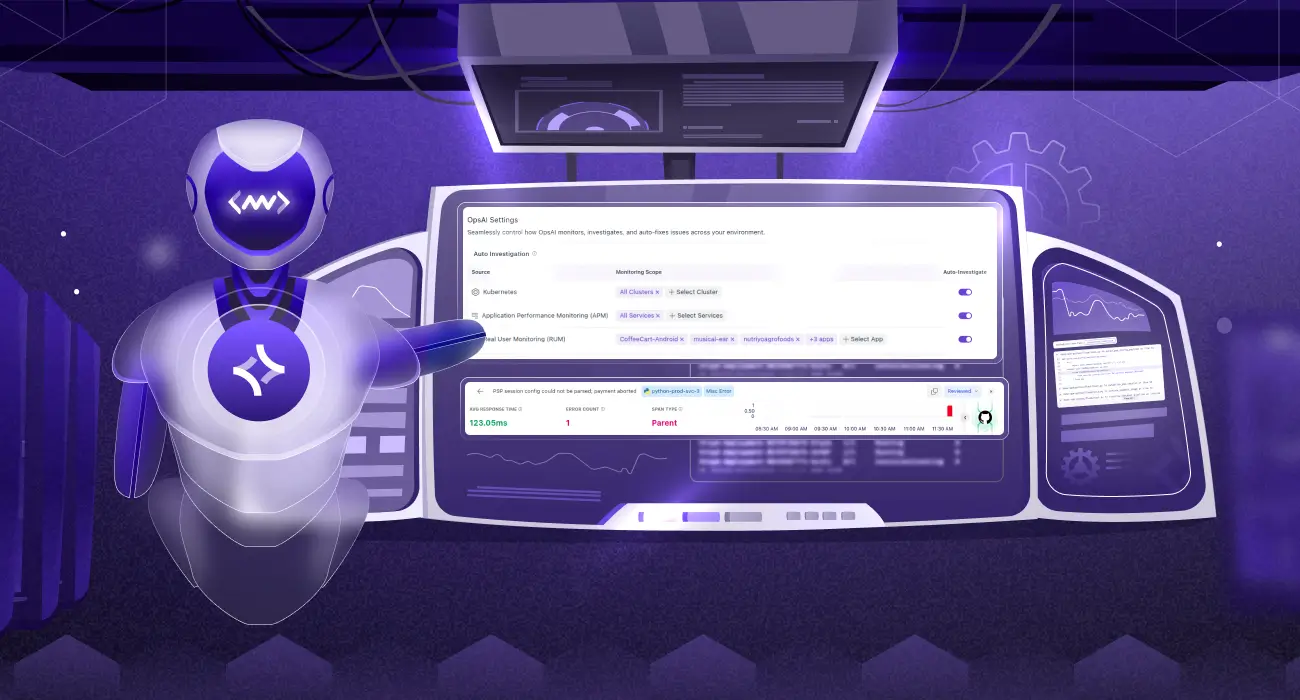
Auto-Generated Postmortems and RCA Summaries: How OpsAI Builds the Incident Timeline So You Don’t Have To
Post-mortems are one of the most valuable SRE practices. They are also one of the most consistently skipped. The reason is structural. Writing an accurate postmortem means reassembling an incident timeline days after it happened, from incomplete memory, scattered Slack threads, and dashboards that have already rolled over. The result is a postmortem that is…
-
Run Production Ahead of the Alert: How an AI SRE Agent Works From Inside Your Observability Platform
Your on-call engineer spends nearly 60% of their week hunting root causes that already happened, while the failed deploy that started it all never triggered a single alert. OpsAI is Middleware’s AI SRE agent: it watches your Kubernetes, APM, RUM, and log telemetry continuously, catches the failures that don’t page anyone, and turns the cause into…
-
Dynatrace vs. New Relic: The Full 2026 Comparison Guide
Choosing between Dynatrace vs New Relic usually comes down to one trade-off: automated depth or flexible breadth. Your app is slow, an alert just fired, and you need to know if it’s the database, the network, or a bad deploy before your users do. This guide compares both platforms across infrastructure monitoring, APM, logs, pricing,…
-
How to Upload Source Maps for Real User Monitoring So Stack Traces Aren’t Minified
Source maps are JSON files that map your minified, bundled JavaScript back to the original file and line number you wrote. Real User Monitoring (RUM) tools use them to turn a.js:1:48213 into checkout/validateCard.ts:42. This guide covers why minified traces show up, how upload-and-match works, and how to automate it in CI/CD. The real challenge isn’t…
-
Incident Correlation: How to Automatically Group Related Alerts From the Same Root Cause
Incident correlation automatically links alerts, logs, traces, and metrics from the same failure into one incident, instead of paging on each signal separately. This article covers how correlation works, the main grouping techniques, and how to apply them when one outage floods your on-call channel with dozens of alerts. The core trade-off is speed versus…
-
OpenTracing vs. OpenTelemetry: Key Differences and Migration Guide
If you searched for opentracing vs opentelemetry because your instrumentation still imports an OpenTracing library, you are looking at a dependency that CNCF archived years ago. This guide lays out what actually changed between the two projects, why the switch matters for your traces today, and a concrete path to move your services onto OpenTelemetry…
-
10 Best Dash0 Alternatives in 2026: Features, Pricing & OTel Support Compared
Looking for Dash0 alternatives usually means you’ve hit one of three walls: Agent0 is still in Beta, there’s no on-call or incident management built in, or you need a self-hosting path Dash0’s SaaS-only model doesn’t offer. This guide compares 10 platforms, including Middleware, Datadog, and SigNoz, across OpenTelemetry support, pricing, and free tiers, so you…
-
Sentry Pricing 2026: Full Cost Breakdown by Plan & Team Size
Sentry bills differently than most observability platforms: instead of metering data volume, it meters events, errors, spans, replays, logs, and attachments each with its own quota and its own overage rate. Overages on the Team plan run from $0.0003625 per error in the 50k–100k tier down to $0.0001500 per error at 20M+ events, while Business…
-
AWS Lambda CloudFormation: How to Create, Deploy, and Manage Lambda Functions
AWS Lambda runs your function code, while AWS CloudFormation defines and manages the function and its related resources, including IAM roles, triggers, and environment variables. This guide explains how to create, deploy, update, troubleshoot, and monitor a Lambda function with CloudFormation. See your Lambda functions the moment they deploy Get invocations, errors, and cold starts…
